Not so long ago, there was a period where we quietly stopped using the word "ontology" in sales conversations for fear it would scare people off. There was a (unwarranted imo) sense in the industry that they were too complicated, too expensive and too academic.
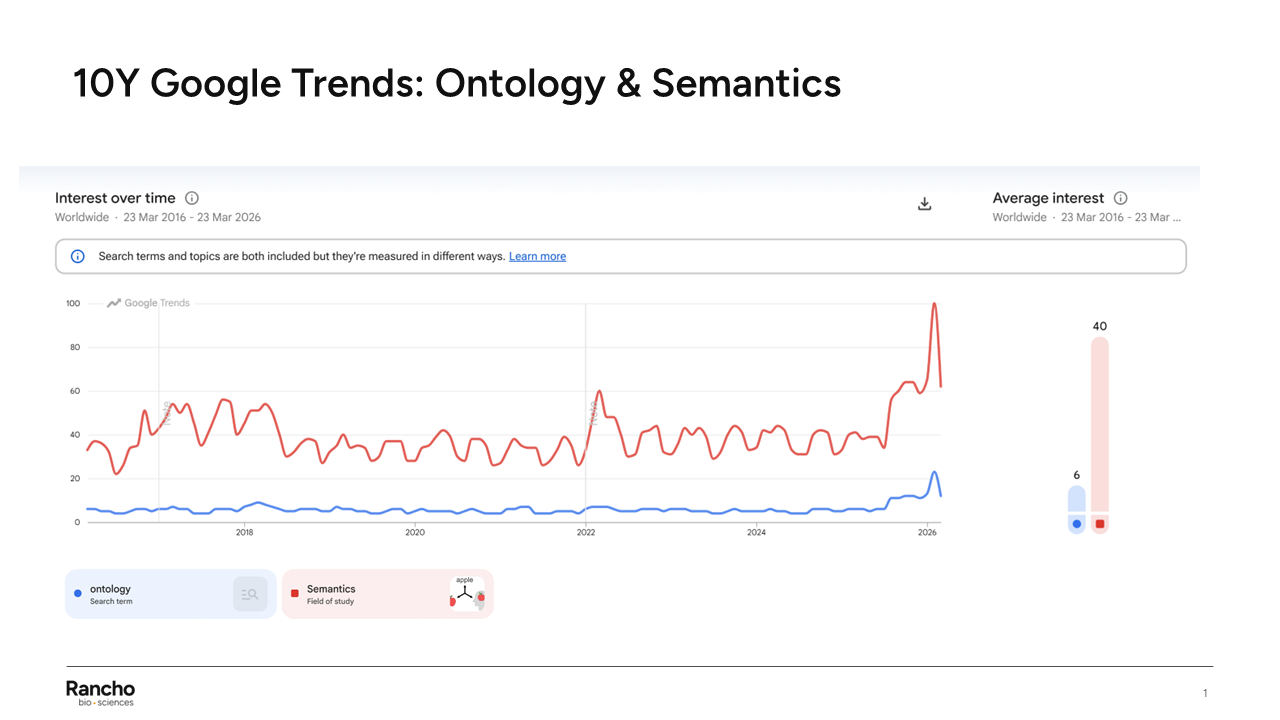
That was a few years ago, but fast forward to Gartner's Data & Analytics Summit 2026 and they're calling semantic layers "critical infrastructure" in the same breath as cybersecurity. Whaaaat. 'Semantics' and 'Ontology' are also trending on Google, as you can see. So what changed?
Well, a few things converged: LLMs made the value of structured knowledge more apparent (and the cost of not having it painful), large players like Palantir and Microsoft started baking ontologies into their data platforms, and the AI debt from inconsistent, unaligned data became harder to ignore.
But "ontology" meaning different things to different people is worth unpacking because not all ontologies are created equal.
The scientific community has spent decades building under the open world assumption: knowledge is incomplete and so are the ontologies that model it. That's given us rich, carefully curated resources like GO, MONDO, and ChEBI that underpin a huge amount of our biomedical research.
Palantir's ontology, and Microsoft's in its Fabric platform, operate under a different assumption. Closed world, closed source and optimised for enterprise data analytics. Useful, but a different beast entirely.
My concern would be that as the big platforms drive mainstream adoption of "ontology", the decades of knowledge from the open source semantics community gets set aside in favour of something closed and easier to manage and sell. That would be a shame and ultimately counterproductive for anyone trying to do serious science on top of these platforms. It will be interesting to see how that evolves.
I'll be talking more about this and more at the Pistoia Alliance 2026 London Conference
Hope to see you there!

.svg)
Comments